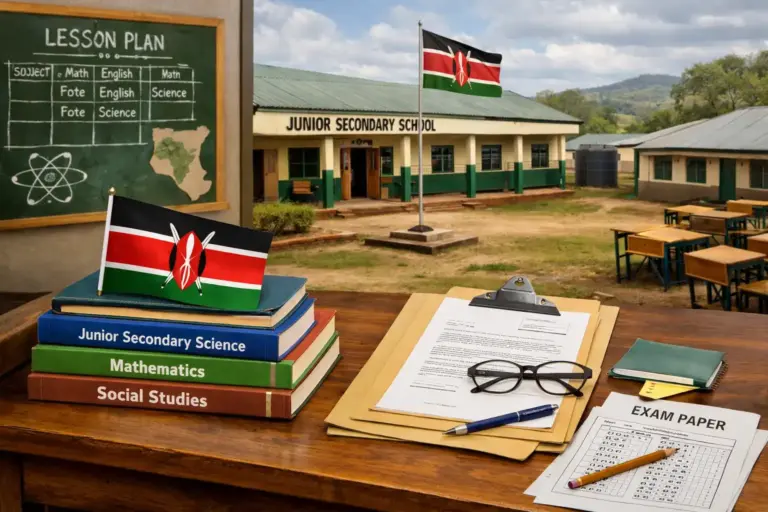
The KJSEA 2026 timetable has been compressed into five working days, ending on Friday, 30 October 2026. KNEC adjusted the schedule to avoid the Monday spillover seen in 2025, a change that gives invigilators and centre staff greater certainty while shifting more hours into Thursday and Friday.
Key Takeaways
- The KJSEA 2026 timetable runs Monday–Friday, with the last session on Friday afternoon.
- Some subjects swapped days so six days of papers fit into five, creating heavier Thursday and Friday sessions.
- Centre managers must follow updated script-control rules, including marking absentees “AB” in red.
- Standard rules still apply: first-session papers start at 8:30 am, no extra time, and phones are banned.
KJSEA 2026 timetable: how the five-day schedule works
KNEC moved papers around so the entire Kenya Junior School Education Assessment (KJSEA) finishes on Friday instead of spilling into the next week. Rehearsal day is held before the real papers begin, and the first paper—English—starts on the Monday morning. The compressed timetable keeps morning start times the same but adds afternoon sessions on Thursday and Friday.
How the timetable was squeezed into five days
Officials kept Day 1 unchanged. Days 2 and 3 traded places: language papers that were previously on Wednesday now sit on Tuesday, and Mathematics plus Agriculture moved to Wednesday. To compress the schedule further, Social Studies and one Creative Arts/Pre-Technical paper moved into Thursday and Friday slots, producing three sessions on those days.
What moved where (quick summary)
- Social Studies (907) moved from the sixth day to Thursday.
- Religious education papers (908, 909, 910) moved from Monday to Friday.
- Pre-Technical Studies (912/1) moved to Friday, swapping with Creative Arts and Sports (911/2).
- Integrated Science Paper 2 (905/2) remains on Friday but shifted to the afternoon and has a shorter duration.
Rules and procedures invigilators must note
Most assessment rules from 2025 remain. Important points for supervisors and invigilators:
- All first-session papers begin at 8:30 am and candidates must be seated 15 minutes earlier.
- No extra time is allowed; exam durations are fixed per paper version (standard, Braille, hearing-impaired).
- Mobile phones and electronic communication devices are banned; possession can lead to result cancellation.
- A candidate who commits an irregularity in any paper may have the whole subject cancelled; widespread irregularities can cancel a centre’s results.
- One supervisor per 200 candidates; each room of up to 20 candidates must have an invigilator.
- Script control forms and seating plans must not be stamped by centre managers; every return polybag must carry a script control form.
- Absentee candidates must be marked “AB” in red beside their assessment number on both the script control form and the return cover page (new for 2026).
Practical guidance for centre managers and teachers
The compressed KJSEA 2026 timetable trades an extra Monday for longer days late in the week. Practical steps to prepare:
- Plan logistics for longer duty hours on Thursday and Friday; expect afternoon sessions that extend to mid-afternoon for standard papers and slightly later for Braille papers.
- Ensure adequate staffing to cover three sessions on Thursday and Friday and smooth transitions between sessions.
- Double-check that scripts are evenly distributed across return envelopes and that every envelope and polybag carries the required control documentation.
- Brief invigilators on updated marking for absentees and the prohibition of stamping script control forms.
Why the change matters to invigilators
The main benefit of the five-day KJSEA 2026 timetable is predictable finish times on Friday, allowing teachers deployed far from home to travel immediately after closing procedures. While the end-of-week days are longer, many invigilators see this as a fair trade-off compared with being held over a weekend for a single final day.
Where to find supporting resources
For teachers and centre staff preparing for end-of-term exams or senior-school transitions, consult related resources and past papers to aid planning and candidate revision. Useful internal resources include the free Grade 10 exams page for senior school transition practice, the CBC curriculum designs for subject alignment, and the JSS curriculum designs for junior secondary guidance.
Final practical dates
Rehearsal day precedes the assessments, the first paper begins on Monday morning, and the last paper ends on Friday, 30 October 2026—typically at 3:00 pm for standard papers or 3:30 pm for Braille versions. After scripts are counted, packed and sealed, invigilators may begin their journey home.