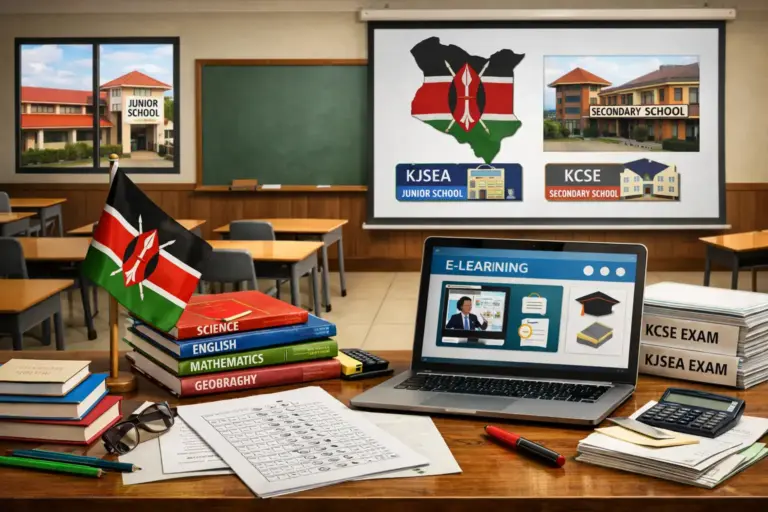
The Basic Education Bill, 2026 formally recognises the comprehensive school model, meaning many schools that host both primary and junior learners will become a single institution with shared governance and funding. This change aligns the law with the Competency Based Curriculum (CBC) and clarifies how schools, counties and the national government must manage learners from pre‑primary through senior school.
Key Takeaways
- The comprehensive school model makes primary and junior school sections one legal institution under CBC.
- Schools that charge illegal tuition face up to KSh 1 million, up to three years in jail, or both.
- Primary and junior sections will have one Board of Management (BOM) and one funding arrangement.
- The Bill bans entrance exams for basic education and strengthens inclusive and special needs provisions.
- County Education Boards and a new Director of Schools Inspections will improve oversight and coordination.
The Basic Education Bill, 2026 and the comprehensive school model
The Bill updates Kenya’s basic education law to match the CBC structure. It officially creates the comprehensive school model, which brings together primary and junior school (Grades 1–9) within the same legal institution. The change moves schools away from the old 8‑4‑4 legal terms and reflects how many schools already operate after CBC rollout.
How comprehensive schools will operate
Under the new model, a school that hosts both primary and junior learners will be one institution, not two separate schools sharing a compound. This means:
- One Board of Management will govern the whole institution.
- The Head of Institution will oversee daily running for all sections, with deputies or senior teachers coordinating specific grades.
- Funding and development planning will be made for the institution as a whole, simplifying resource allocation for classrooms, labs, ICT and sanitation.
What this means for teachers, parents and learners
Teachers may see changes in deployment and staffing as schools streamline administration. The Bill highlights free and compulsory basic education and strengthens enforcement:
- Public schools are prohibited from charging tuition. Violations carry up to KSh 1 million fine, up to three years imprisonment, or both.
- Parents who deliberately prevent children from attending school may face penalties up to KSh 5 million or up to five years in jail in specified cases.
- Schools cannot use entrance exams for admission to basic education and must not discriminate by ethnicity, sex, religion, disability or language.
- If a learner is wrongly denied admission, parents can complain to the County Education Board and appeal to the Education Appeals Tribunal.
Stronger inclusion, inspections and support systems
The Bill strengthens special needs education by linking it to constitutional rights and requiring improved data and support through institutions such as the Kenya Institute of Special Education and Assessment and Resource Centres. Quality assurance is also boosted by creating a statutory office of the Director of Schools Inspections and empowering school inspectors to check curriculum delivery, assessment, financial management and governance.
Funding, scholarships and KEMIS coordination
Comprehensive schools will change how government and partners plan funding. The Bill calls for a coordinated scholarships and bursaries system with a central database to avoid duplication and target needy learners. The Kenya Education Management Information System (KEMIS) will remain central to maintaining learner and institution data for planning and support.
Admissions, anti‑discrimination and redress
The Bill removes entrance exams as a tool to bar learners from basic education. It also makes clear that a missing birth certificate cannot be a reason to deny admission. Parents who face unfair admission decisions are advised to seek timely recourse through the County Education Board, which must respond within 14 days.
Practical steps for schools and stakeholders
Schools and education managers should begin preparing for implementation by:
- Reviewing governance documents to align with a single BOM and institutional structure.
- Planning budgets and development projects for the institution as a whole rather than separate sections.
- Updating records on KEMIS and preparing staff roles for larger, integrated institutions.
- Training staff on inclusive practice, admission rules and the new inspection expectations.
Where to find CBC resources and guides
To support the transition, schools and teachers can access CBC curriculum and teaching resources such as CBC curriculum designs, subject guides for junior secondary at JSS curriculum designs, and materials for senior school planning at Grade 10 curriculum designs. These resources help align lesson planning and assessment with the comprehensive school approach.
Final note
The Basic Education Bill, 2026 aims to create clearer legal structure for CBC implementation by formalising the comprehensive school model. Schools, teachers and parents should prepare now for governance, funding and staffing changes while using available CBC resources to ensure smooth transition and continued learning for all learners.