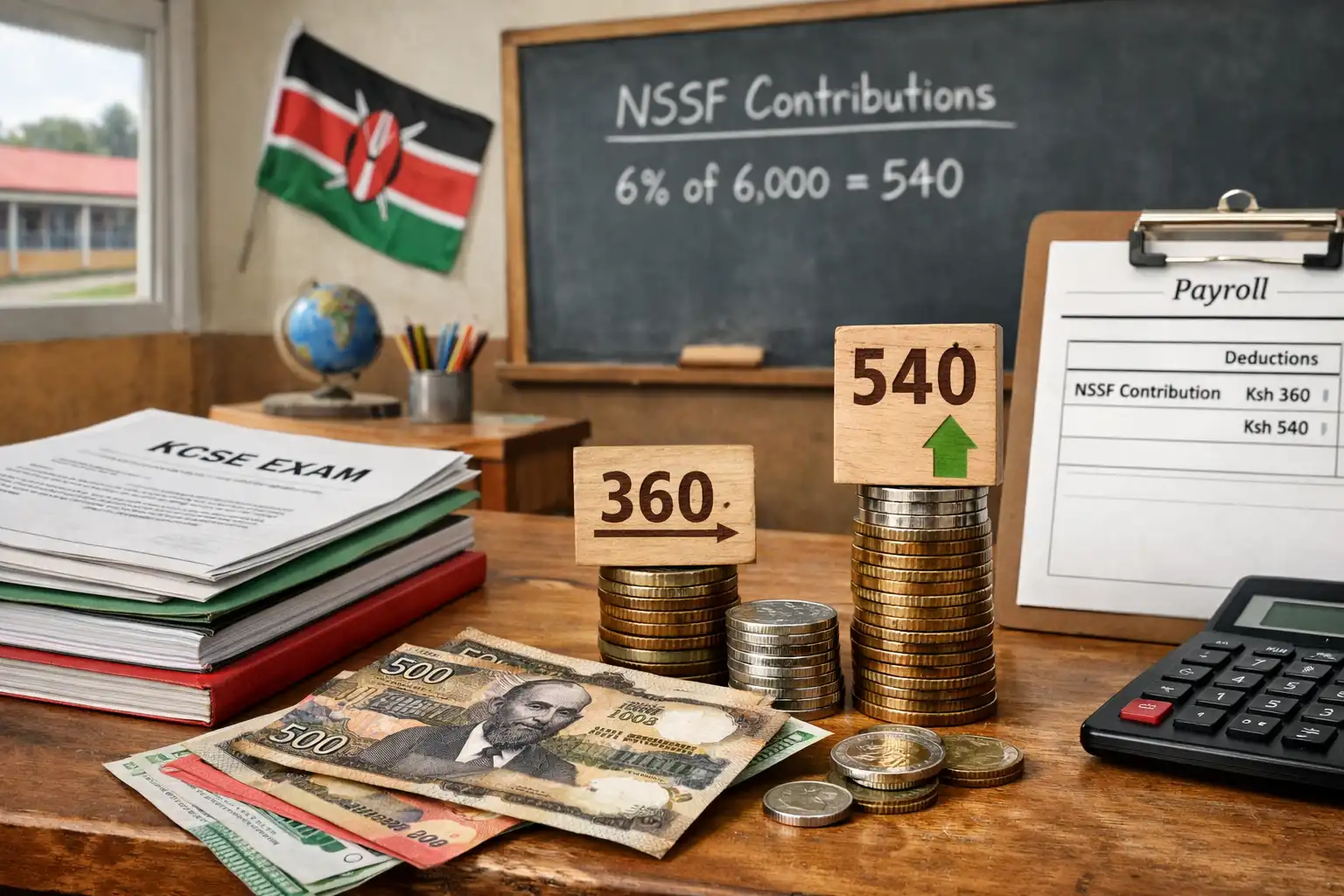
Teachers will see an increase in their NSSF deduction from Sh360 to Sh540 each month after the legal NSSF base was raised. The change, effective February 1, raises the lower earning limit and expands the contribution brackets, meaning both employees and employers will pay higher mandatory pension contributions.
Key Takeaways
- NSSF deduction for teachers increases from Sh360 to Sh540 per month (employee portion) when the base rises to Sh9,000.
- The Teachers Service Commission (TSC) will match the employee contribution, so the combined monthly contribution per teacher becomes Sh1,080 at the new base.
- The change is part of the final phase of NSSF rate adjustments and affects all employees paid under the NSSF Act tiers.
- Higher contribution bands widen the income subject to deductions — the upper limit rose to Sh108,000 and the lower limit to Sh9,000.
- Teachers’ take-home pay will feel added pressure alongside other statutory deductions and loan obligations.
NSSF deduction: What changed
The law sets a fixed statutory base used to calculate NSSF contributions. Under the previous base of Sh6,000, employees paid 6% (Sh360) while employers matched with Sh360. The revised lower earning limit is now Sh9,000 and the 6% employee share on that amount equals Sh540. Employers must also contribute Sh540, increasing the total monthly employer–employee contribution to Sh1,080 per worker at the first tier.
How the two-tier system works
The NSSF contribution system uses two tiers to determine monthly contributions:
- Tier 1: On the first Sh9,000 of salary, both employee and employer each pay 6% (currently Sh540 each).
- Tier 2: On earnings between Sh9,001 and Sh108,000, the combined contribution rate can reach 12% across employee and employer shares.
Because the system applies statutory bands rather than individual salaries, the initial Sh540 deduction is uniform across public servants earning within these limits.
Impact on teachers’ pay
Many teachers already face multiple deductions on their payslips. Typical payroll items include a housing levy, Social Health Insurance Fund (SHIF), provident fund contributions, union and agency fees, and loan repayments. The higher NSSF deduction further reduces disposable income and may affect teachers’ ability to meet day-to-day expenses.
Employers and employer groups have raised concerns. The Federation of Kenya Employers (FKE) says the increase supports long-term pension savings but warns about the cumulative effect of mandatory deductions on take-home pay. FKE calls for enterprise-level measures to balance compliance with employee affordability.
What teachers should expect
Starting with the February payroll, teachers should check their payslips to confirm the new NSSF entries. Expect these changes:
- A visible employee deduction of Sh540 (if the base is Sh9,000).
- A matching employer contribution of Sh540 recorded by the employer.
- An upward adjustment in maximum potential monthly deductions for higher earners due to the widened bracket to Sh108,000.
Ways teachers can prepare
To manage the reduced take-home pay, teachers can consider:
- Reviewing and adjusting monthly budgets to account for the higher NSSF deduction.
- Checking payroll details and raising payroll discrepancies with school finance officers promptly.
- Exploring financial planning resources or low-cost saving options to cushion short-term liquidity needs.
Frequently asked questions
Does the NSSF increase affect only teachers? No. The change applies to all employees covered under the NSSF Act once the new contribution phase is implemented.
Will higher contributions improve pension outcomes? Yes — higher statutory contributions increase retirement savings over time. However, the short-term impact reduces disposable income.
Further resources
If you are also preparing students or yourself for upcoming exams while adapting to payroll changes, you may find useful study and curricular materials:
- Free CBC exam papers and revision materials for classroom practice and assessment planning.
- Free KCPE exams for primary school revision resources that teachers can use with learners.
- Free KCSE revision exams for secondary school exam preparation and student support.
Monitor your payslip after the February payroll and discuss any discrepancies with your school finance office. Keeping a simple monthly budget and using available revision and curriculum resources can help manage both professional duties and personal finances during the change in NSSF rates.