The KNEC packaging guidelines explain how KPSEA and KJSEA examination materials must be handled, packed and delivered to preserve exam integrity and prevent losses or delays. Follow these procedures carefully to ensure correct KPSEA packing, accurate KJSEA packing and safe OMR handling from the exam room to the container.
Key Takeaways
- Follow KNEC colour codes for cartons, polybags and return envelopes to avoid mixing assessments.
- Confirm each KJSEA paper format before packing: Multiple Choice, Structured or Mixed.
- OMR sheets must be clean, crease-free, with responses shaded in pencil and nothing placed between sheets.
- Keep Sheet 1 (centre details) separate from script envelopes and do not stamp Sheet 2 to preserve anonymity.
KNEC packaging guidelines: colour coding and materials
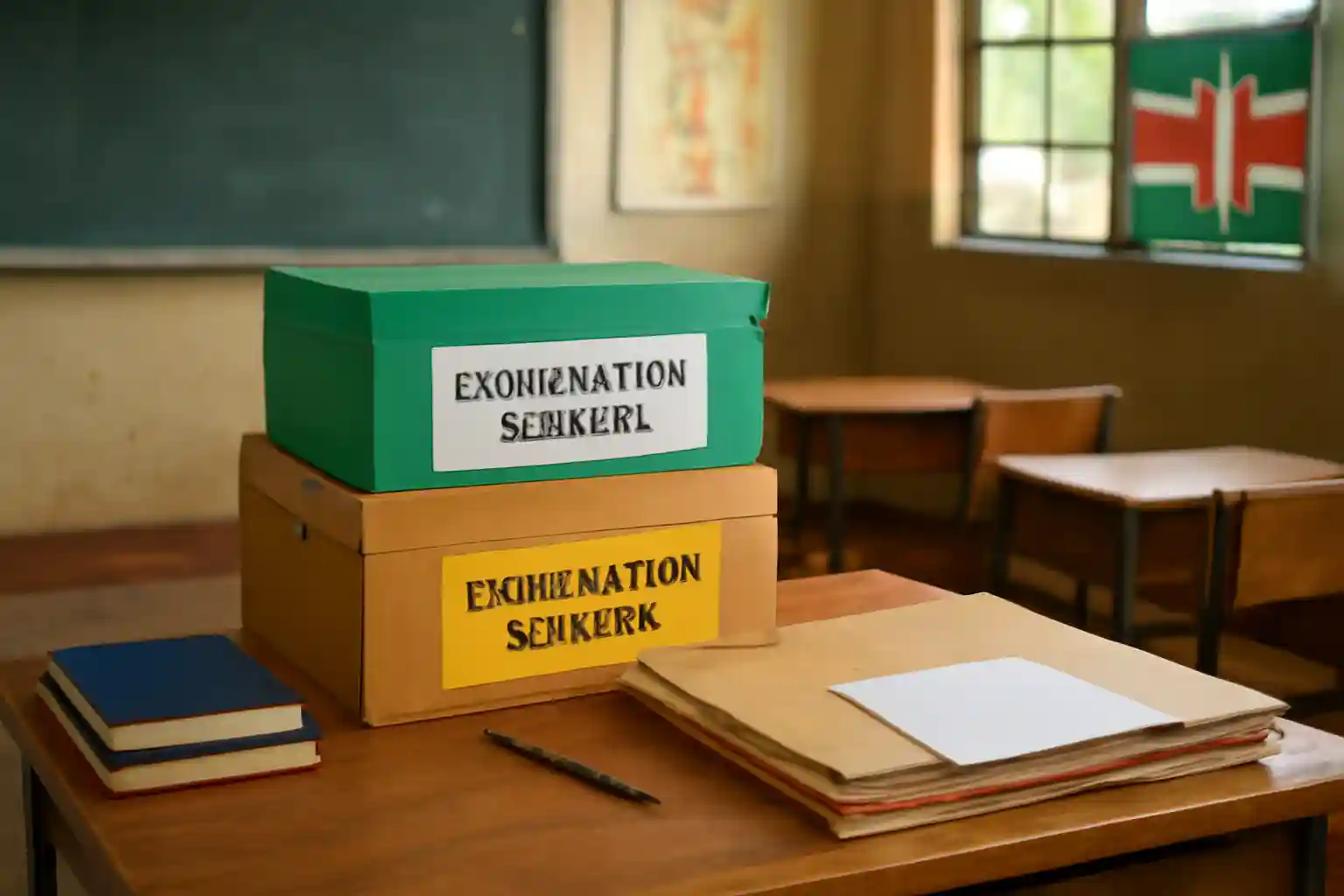
KNEC uses clear colour codes so different assessment materials never get mixed. KPSEA cartons carry white labels with small pink stickers while KJSEA cartons use green labels. Both assessments use blue carton straps. Question paper polybags are light green for KPSEA and blue for KJSEA. Session cover pages also have assigned colours: KPSEA uses pink for Session 1 and blue for Session 2; KJSEA adds green for Session 3.
Return envelopes follow the same system: KPSEA script return envelopes are black and KJSEA return envelopes are green. Store all items separately in the container from receipt and ensure straps and labels remain visible and unblocked.
Know the KJSEA paper formats before packing
Confirm the format of the day’s KJSEA paper because packing differs by type:
- Multiple Choice only: Includes question papers and OMR sheets (no perforation). Pack like KPSEA OMR packets.
- Structured only: Personalised, perforated question papers with no OMRs. These are treated as answer scripts.
- Mixed format: Personalised, perforated question papers plus OMRs. Question papers are handled as scripts; OMRs are packed like KPSEA sheets.
Packing OMR-based papers
At session end the supervisor must account for every script publicly, then hand materials to the Centre Manager in two groups:
- Script return envelopes: Hold OMR sheets. Each envelope must include a Return Cover Page with the barcode facing upward for scanning.
- Used question paper polybags: Contain all question papers (used and unused, including for absent candidates) and the Supervisor’s Instruction Sheet. Staple these polybags.
Packing structured and mixed-format papers
For structured papers and the question-paper portion of mixed-format papers, every script return envelope must contain:
- A Return Cover Page with the barcode facing up
- A Script Control Form
The used question paper polybag must include:
- Sheet 1 – the question paper cover page with centre details and candidate index list (must not be in script envelopes)
- The small clear envelope containing counterfoils
- Unused question papers (including for absent candidates)
Handling OMR sheets and absent candidates
OMR sheets are delicate. Shade MCQ responses with a pencil inside the ellipses only; do not strike through. Structured responses should be written in biro; only clear-bodied pens are allowed. Remind candidates not to cut off personalised detail areas that link the sheet to the learner.
When packing, place nothing between OMR sheets — no cover pages, seating plans or loose notes. Verify and arrange OMRs in ascending order by index or assessment number. If a candidate is authorised to answer on the question paper, enclose their OMR with that question paper inside the OMR return envelope.
Absent candidates: the supervisor marks AB on the correct cover page; the Centre Manager reports absent candidates on the CP2 portal daily. Shade the absent candidate’s OMR as AB and pack it with present candidates’ OMRs. Do not issue an absent candidate’s OMR to another candidate under any circumstance.
Hardship cases
A candidate who cannot reach their centre but sits the assessment must not be recorded as absent. Report the case to KNEC, capture where they sat on the Script Control Form and Certificate of Supervision, and record it on the CP2 portal. Pack their answer sheets in a special Hardship return envelope. Within the sub-county, these scripts travel in special envelopes and a green bag to KNEC. For non-personalised papers, the counterfoil should remain attached and candidates must write required identifiers on the sheet.
At the container and final checks
The Centre Manager, escorted, hands over return polybags, the counterfoil envelope, unused papers for absent candidates and empty question paper packets, signing the receiving printout and accounting for every envelope and candidate. The SCDE removes old labels carefully, fixes pre-printed return labels (showing assessment, packet type, barcode and box number) and checks that the barcode will not be blocked when the box is closed.
Packets are verified against issuing and receiving printouts, placed in the right cartons, and temporarily sealed with masking tape. Counterfoils go into a separate box. Any discrepancy must be resolved before materials leave the container and reported to KNEC with full details.
Packing checklist
- Confirm the KJSEA paper format for the day before packing.
- Verify envelope colours: black for KPSEA, green for KJSEA.
- Place a Return Cover Page with barcode up in every envelope.
- Add a Script Control Form wherever answer scripts are packed.
- Keep Sheet 1 out of script envelopes and do not stamp Sheet 2.
- Put nothing between OMR sheets; shade AB for absent candidates.
- Staple used question paper envelopes and keep carton barcodes visible.
Resources for teachers and supervisors
For practice materials and curriculum support that complement exam procedures, see the CBC exam resources, access sample primary papers at the KCPE past papers collection, or review curriculum design guidance in the CBC curriculum designs. These resources can help supervisors and centre staff understand formats and common packing requirements.