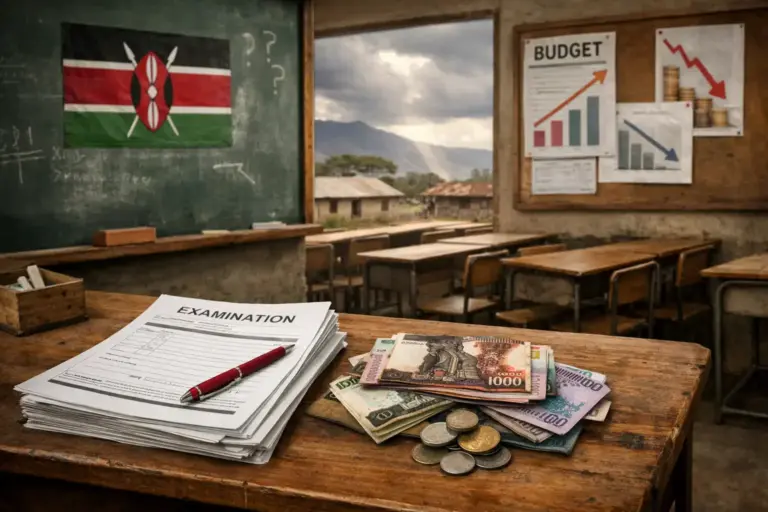
The Teachers Service Commission (TSC) processed July payrolls at the old pay rates. The planned salary increases tied to the 2025–2029 Collective Bargaining Agreement (CBA) were not applied in July but will be implemented in August 2026 with full backdated arrears to July 1st. This article explains the reasons for the delay, what teachers should expect, and the timeline ahead for the TSC July salaries.
Key Takeaways
- July payslips were processed at existing rates; the second phase of the CBA will be paid in August 2026 with July arrears.
- The postponement is due to fiscal timing and an administrative migration to the Government Human Resource Information System (GHRIS).
- The 2026/2027 budget set aside Ksh 8.4 billion for the teachers’ Phase II adjustments within the wider Sh33 billion CBA.
- Allowances (housing and commuter) will be revised for lower-earning civil servants to ease the effect of inflation.
- Teachers should check their August payslips carefully and confirm personal data is accurate on official payroll systems.
TSC July salaries: What teachers need to know
The immediate concern for most educators is simple: July payrolls did not include the expected increases. The government has confirmed the adjustments will be in the August payroll and will include back pay for July. The delay is a scheduling decision, not a cancellation.
Why the delay happened
The government cited two main reasons for postponing the rollout. First, revenue collection for the current fiscal period is slightly below projections, creating a short-term liquidity constraint. Second, an administrative move to centralize payrolls under the Government Human Resource Information System (GHRIS) requires that departments complete data migration before new rates are applied.
- Fiscal caution: implementing many public-sector pay rises at once needs careful cash management.
- Payroll accuracy: migrating to GHRIS aims to remove errors and reduce payments to inactive or duplicate records (often called ghost workers).
Legal and budget foundations
The salary changes rest on newly gazetted SRC regulations and the national budget for 2026/2027. The Salaries and Remuneration Commission (SRC) issued the necessary regulatory framework, and the Treasury allocated funds specifically for the CBA phases. For teachers, Ksh 8.4 billion is earmarked for Phase II; an additional Ksh 2 billion supports broader civil service pay reforms.
How much to expect
The CBA uses a phased model that gives larger percentage increases to lower-paid cadres and smaller increases to higher-paid cadres. Broad figures announced include:
- Percent range: roughly 5% to 29.5% depending on job group.
- Basic pay increases: reported estimates range from about Ksh 2,359 to Ksh 17,416 by notch.
- Allowances: housing allowance may rise to approximately Ksh 6,000 and commuter allowance to about Ksh 5,000 for the lowest-paid bands.
Exact figures will be visible on August payslips once TSC completes the GHRIS migration and SRC directives are applied.
Timeline and the roadmap to 2028
- Phase 1 — Completed earlier under the 2025–2029 CBA.
- Phase 2 — To be implemented in August 2026 with backdated pay to July 1st.
- Phase 3 — Planned for July 2027, contingent on the 2026/2027 budget review.
- Phase 4 — Final scheduled adjustments in July 2028 to complete the four-year plan.
Practical steps for teachers
To prepare for the August adjustment and to avoid surprises, teachers should:
- Keep pay slips and bank statements for July and August for reference.
- Verify personal details with your school payroll officer so the correct records migrate to GHRIS.
- Review new allowance rates and expected arrears once TSC publishes official breakdowns.
- Plan household budgets with the understanding that the August payslip will reflect the cumulative change.
Teachers seeking curriculum and classroom resources while awaiting administrative updates can use free exam and teaching materials such as free CBC exams, and refer to free CBC curriculum designs for lesson planning. Secondary teachers preparing students for national exams may find the free KCSE revision exams helpful.
Impact on morale and teaching quality
Financial security supports teacher morale and professional stability. The CBA aims not only to raise pay but to adjust allowances that directly affect living costs, like housing and transport. When allowances better match actual costs, teachers can reduce commute times or live closer to work, which can improve attendance and classroom focus.
Common questions
- Will teachers receive July pay for the increase? Yes — increases will be backdated and paid in August.
- Is the delay permanent? No — the government confirmed implementation in August after completing GHRIS migration and SRC clearance.
- What if my payslip is wrong in August? Report errors immediately to your school payroll officer and keep documented evidence.
In summary, the TSC July salaries were processed at old rates because of timing and administrative reasons. Teachers should expect Phase II CBA adjustments in August 2026 with full arrears to July. Verify your payroll records, prepare household budgets accordingly, and use available teaching resources while awaiting the updated payslips.